





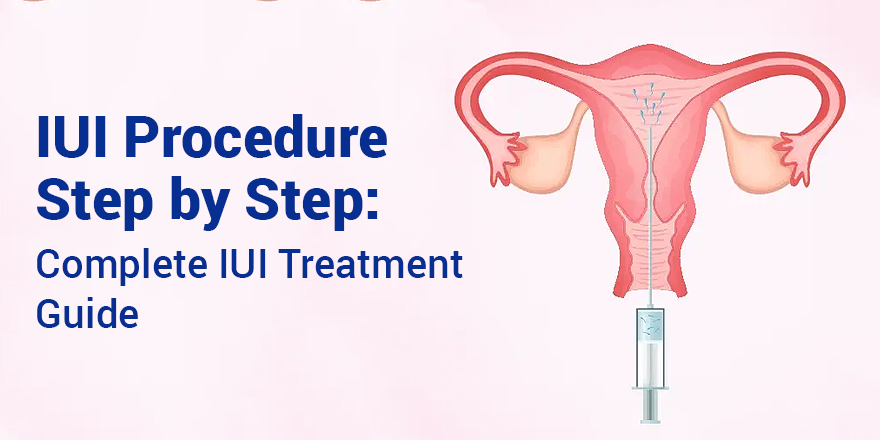
IUI Procedure Step by Step: Complete IUI Treatment Guide

While infertility could be a taxing experience, modern-day fertility treatments allow millions of couples to become parents. One of the easiest fertility treatments is the IUI procedure step by step. In case your doctor recommends this, having an idea of the IUI treatment would certainly be helpful.
As opposed to IVF, IUI treatment is non-invasive, relatively cheaper, and is usually recommended for couples who have mild infertility problems. This blog will give a detailed explanation about the IUI procedure step by step, what happens at each stage, who qualifies, the success rate, benefits, risks, and preparation for the procedure.
For those interested in seeking the Best IVF Centre In India, consultation from fertility experts could help in deciding whether to undergo IUI or IVF.
What Is IUI Treatment?
In IUI treatment, which stands for Intrauterine Insemination, specially processed semen is placed directly into the womb of the woman during ovulation. This is done to enhance the chances of fertilization since the process will help the sperm cells to easily reach the egg cell. The process of IUI treatment is fast and painless.
Who Can Opt for IUI Treatment?
For patients who are suffering from the following conditions, the doctors will suggest the use of IUI procedure step by step:
When the fallopian tubes are blocked or when the patient suffers from severe male infertility or severe endometriosis, then IUI treatment is not suitable for such patients.
IUI procedure step by step
A step-by-step IUI procedure reduces the burden of treatment. What occurs during the IUI procedure?
Step 1: Fertility Consultation
The first step in the IUI procedure step by step is to consult with a fertility expert. During this step, the doctor will examine the following:
Several tests may be conducted to see if the IUI process is right for you:
Step 2: Ovulation Monitoring
This is another step in the step-by-step IUI procedure process.
Ovulation is monitored using the following methods:
One of the most important aspects of the successful IUI treatment process is timing.
Step 3: Fertility Medications (When Necessary)
Some women have a natural cycle IUI, while other women use fertility medications to induce egg.
Commonly used fertility medications are as follows:
The aim is to make one or more healthy follicles.
Step 4: Trigger Shot
When the follicles become sufficiently large, your doctor will give you an injection of Trigger Shot. The injection:
The insemination procedure is scheduled for 24 to 36 hours following the trigger shot.
Step 5: Sperm Collection and Preparation
On the day of the procedure, the male partner provides a sperm sample; if using donor sperm, it is appropriately prepared.
The sperm sample undergoes a procedure known as sperm washing in the laboratory. This entails:
This procedure greatly increases the probability of conception through the IUI treatment procedure.
Step 6: The IUI Procedure
This step is the core of the IUI procedure, step by step.
The procedure takes only 10-15 minutes.
The steps involved in the process include the following:
The procedure is relatively painless, but some women may experience cramping.
Anesthesia and hospitalization are not required.
Step 7: Rest Post-Procedure
Women can rest for 10-15 minutes after the IUI procedure.
Women can:
Progesterone pills are prescribed for the support of implantation.
Step 8: The Two Weeks Wait
The last phase of the step-by-step IUI procedure is one of the most emotional stages. During the two weeks after the procedure:
Step 9: Pregnancy Test
Approximately 14 days after your IUI procedure, your doctor will suggest that you undergo a blood pregnancy test.
Further IUI procedures or IVF Treatment In India are suggested as per the condition of your infertility.
Duration of IUI Process
The full process of IUI usually takes about 2-4 weeks depending upon the menstrual cycle.
Success Rate of IUI Treatment
The success rate of the IUI treatment procedure depends on various factors like:
On average, the pregnancy rate per cycle is 10%-20%, with a higher success rate among young women.
However, if the IUI process does not prove to be successful after several cycles, fertility specialists will recommend that patients undergo IVF Treatment In India.
Advantages of the IUI Procedure
Some of the most important benefits of the IUI treatment process are:
What are the risks involved in IUI?
The IUI procedure, in general, is pretty safe, and some of the minimal risks associated with it are:
Your fertility specialist will keep a check on the cycle to avoid such complications.
Suggestions to Improve IUI Success
Although there is no sure-shot way to increase success, you can try some of the following tips:
Selecting the best IVF centre in India with fertility specialists and laboratories can also contribute to your success.
When Should IVF Be Opted For Instead?
Though IUI treatment is highly beneficial for several couples, IVF can be opted for if any of the following occurs:
Final Thoughts
The knowledge of IUI treatment step by step allows approaching fertility treatment with more confidence and reasonable expectations. Every step of the IUI treatment process includes evaluation of your fertility levels, ovulation prediction, preparation of the sperm, and insemination. While each infertility case is special, IUI treatment gives hope for many couples struggling with infertility issues. Consultation with experienced fertility experts at the Best IVF Clinic in India guarantees personalized treatment with the best reproductive technologies. In case IUI is not effective for you, experts will also talk to you about advanced treatments such as IVF Treatment in India.
Frequently Asked Questions
1. Is the IUI procedure painful?
No, the IUI procedure is not usually painful. Women experience some mild discomfort or cramps during the insertion of the catheter inside the uterus. The procedure is fast and takes about 10-15 minutes to be completed without the need for anesthesia.
2. How effective is IUI treatment?
The effectiveness of IUI treatment relies on several parameters, such as a woman's age, the quality of sperm, ovulation, and the reasons for infertility. On average, the success rate is 10-20 percent per cycle; however, there are better chances for younger women (under 35 years old).
3. How much time does the IUI process take?
The whole IUI process can take 2-4 weeks, including evaluation of fertility, ovulation tracking, medication intake (if necessary), insemination, and a two-week wait to get pregnant test results.
4. Who is an ideal candidate for IUI treatment?
IUI treatment can be prescribed to couples with infertility of unknown reasons, mild male infertility, ovulation problems, abnormal cervical mucus, and mild endometriosis. IUI is also a good choice for single women or gay couples with the help of donor sperm.
5. What is the number of cycles that I have to undergo for IUI before opting for IVF?
The general recommendation by fertility experts is that one needs to undergo 3 to 6 IUI cycles before IVF treatment in India. This will depend on a range of factors, such as your age and your diagnosis of infertility.