




Bilateral Polycystic Ovaries: Meaning, Symptoms, Causes, Diagnosis and Treatment

If you get told you have bilateral polycystic ovaries on an ultrasound, it can feel really scary, especially if you’re trying to understand your fertility and conception chances. But finding that “polycystic” look on imaging doesn’t automatically mean you have Polycystic Ovary Syndrome, PCOS. Not always, anyway. In simple terms, bilateral polycystic ovaries means that both ovaries have a polycystic ovarian morphology, also called PCOM. Usually this means you can see lots of small follicles, and/or the ovary volume is a bit increased on ultrasound. PCOS, on the other hand, is a broader hormonal condition, and it can’t be diagnosed from ultrasound alone. Current international guidance says PCOS diagnosis is based on a set of criteria, not just one image detail.
What Are Bilateral Polycystic Ovaries?
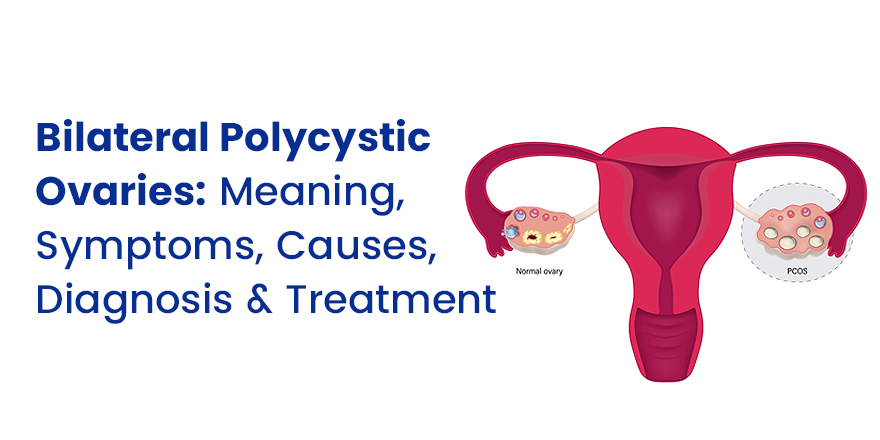
Bilateral polycystic ovaries are ovaries where the ultrasound appearance suggests a polycystic ovarian morphology.
The word “polycystic” can confuse people, because it sounds like there are harmful cysts that must be taken out. Yet what it usually points to is the presence of many little follicles inside the ovary. If both ovaries look like that, they might be referred to as:
- Bilateral polycystic ovary
- Bilateral polycystic ovarian pattern
- Bilateral polycystic ovarian morphology
- Polycystic morphology of ovaries
Bilateral PCOD
It’s a feature that can show up in PCOS, but it isn’t the whole story. Per the international PCOS diagnostic rules, PCOS is diagnosed when at least 2 out of 3 findings are present—hyperandrogenism, ovulatory problems, and polycystic ovaries (or a related substitute marker), in adults, after ruling out other conditions.
Is Bilateral Polycystic Ovary the Same as PCOS?
No, they are not the same thing, and it’s important to keep them separate. You can have bilateral polycystic ovarian morphology and still not meet the diagnosis for PCOS. Some women have this ultrasound pattern, yet have regular cycles, hormone results within the normal range, and they don’t have signs of hyperandrogenism.
But the reverse also happens. Some people can have PCOS, while the ultrasound may not clearly show a polycystic ovarian pattern. So if your doctor writes “bilateral polycystic ovaries” in your report, that alone doesn’t automatically equal PCOS. Your clinician generally checks other things too, like your menstrual history, symptoms, hormone test results, and possible alternative causes.
What Causes Bilateral Polycystic Ovarian Morphology?
The reasons behind polycystic ovarian morphology differ from person to person. In situations where polycystic ovaries happen as part of PCOS, there may be a mix of hormonal and metabolic contributors.
Common causes linked to PCOS include:
- Higher androgen levels (or androgenic activity)
- Ovulatory dysfunction, meaning ovulation doesn’t occur regularly (or at all)
- Metabolic problems, including insulin resistance
- Genetic tendency, or inherited risk for PCOS
- Irregular menstrual cycle
That said, bilateral polycystic ovarian morphology by itself doesn’t mean you have a specific disease or that you “need treatment” right away. The ultrasound measures used to label polycystic ovarian morphology depend on the follicle count, and sometimes on ovarian size. For adults, the 2023 international guidance uses follicle number per ovary, with cutoffs that can vary based on the ultrasound method and how measurements are taken.
Symptoms of Bilateral Polycystic Ovaries
Bilateral polycystic ovaries, by themselves, usually do not cause symptoms. Any symptoms that appear are typically related to PCOS or some other hormonal imbalance.
Possible symptoms include:
1. Unusual Menstrual Cycle
Irregular periods, periods that come less often, or even no menstruation can occur because ovulation is irregular.
2. Problems Fertilizing the Egg
With an irregular ovulation cycle, there will be difficulties determining the ovulatory phase. Having polycystic ovaries does not necessarily mean that a woman is infertile.
3. Excessive Hair on the Face or Body
The excess of hormones can trigger additional hair growth on the face and body for certain women.
4. Acne and Oily Skin
Androgen-related hormonal changes might result in excessive acne formation and skin oiliness.
5. Weight Fluctuations
Some women with this condition suffer from problems with weight control. Nevertheless, PCOS can affect people with diverse weight ranges.
6. Hair Loss
Due to changes related to increased hormones, hair thinning or even hair loss might appear. Not all women with the polycystic ovarian syndrome will suffer from these symptoms.
How Does Bilateral Polycystic Ovaries Get Diagnosed?
It usually starts with a pelvic ultrasound where the doctor can see the ovaries and determine follicle count and ovarian volume.
But ultrasound is just one method of testing.
Depending on your symptoms and health history, your doctor can suggest:
- Menstrual cycle and ovulation history
- Physical examination
- Tests for hormonal balance
- Tests for androgens
- Tests for blood sugar
- Testing for thyroid
Additional tests to diagnose other similar conditions
For adult patients with menstrual disorders and hyperandrogenic symptoms, an ovarian ultrasound may not be required at all for PCOS diagnosis.
Does Bilateral PCOD Affect Fertility?
Bilateral PCOD is just an unofficial term referring to a polycystic-looking ovaries condition, but one should understand that this ultrasound finding is different from PCOS.
If the patient has regular ovulation, this ovarian appearance will probably not affect fertility at all. However, if a patient suffers from polycystic ovaries and has irregular ovulation, she might conceive more easily because she doesn’t release eggs regularly.
The good thing is that issues relating to fertility resulting from ovulatory dysfunction may have solutions.
Based on the individual scenario, treatment will involve lifestyle interventions, drugs that help to stimulate ovulation, or ART such as IUI or IVF procedures.
Treatment for Bilateral Polycystic Ovaries
There is no specific treatment aimed at “removing” polycystic ovaries.
The approach to treatment will depend on the presence of PCOS, symptoms, metabolic issues, or fertility challenges.
Treatment may involve the following recommendations by your physician:
Lifestyle changes: Exercise, proper nutrition, sufficient sleep, and healthy weight management are important for general metabolic and reproductive wellbeing.
Medication: Depending on your symptoms and the goal of treatment, medication might be recommended to control menstrual problems, androgen excess or metabolic abnormalities.
Infertility therapy: In case of infertility, depending on ovulation state, age, ovarian reserve, sperm parameters, and fallopian tube status among others, treatment is decided upon.
In case of failure to conceive through natural means or due to other fertility factors, an infertility specialist might consider ovulation stimulation, IUI or IVF in India.
When Should You See a Fertility Specialist?
You might consider consulting a gynecologist or a fertility specialist when you have:
- Extremely irregular or no menstruation
- Problem getting pregnant
- Excess androgen symptoms
- Major or unexpected weight changes
- Recurrent abnormal ultrasound results
- Problems related to ovarian function or fertility
Bilateral Polycystic Ovaries and Ultrasound
Bilateral polycystic ovaries noted in ultrasound examination need to be considered in relation to the whole health and reproductive history of the patient.
Bilateral Polycystic Ovaries and IVF
For women having fertility treatments, polycystic ovaries could be important as their ovaries would react differently to the medications used for stimulation. Fertility specialists tailor their approaches to the specifics of treatment and closely monitor ovarian response.
In case of IVF, the approach to treatment depends on various factors including age, ovarian reserve, past fertility history, semen quality and causes of infertility - not just the ultrasound report with bilateral polycystic ovaries.
A reliable choice of an experienced IVF Hospital in India or an Infertility Hospital in India Seeds of Innocens IVF, would provide a comprehensive evaluation of the patient for fertility treatment.
The bottom line
Bilateral Polycystic Ovaries/Bilateral Polycystic Ovarian Morphology is merely an ultrasonic finding, which suggests that both your ovaries have a special follicle pattern/ovarian appearance. However, it does not mean that you have polycystic ovaries and are infertile.
In case of your menstrual irregularities, problems with conception, acne, increased facial hair growth, or other signs of hormonal imbalance, the consultation of a gynecologist or fertility specialist may help find out the reason of your problem.
With the correct diagnosis and personalized approach to your treatment, you will be able to control the symptoms of your PCOS-related ovulatory disorder and conceive. In case if conception requires a special treatment, Seeds of Innocens IVF is one of the Best IVF Centre in India determine what method of conception is more suitable for you: ovulation treatment, intrauterine insemination (IUI), or IVF.
Frequently Asked Questions
1. Is bilateral polycystic ovaries dangerous?
No, it is not. The polycystic ovarian appearance found on ultrasound is not the indicator of any dangerous condition or PCOS.
2. Am I able to get pregnant even when having bilateral polycystic ovaries?
Yes. It is common for females with such ovaries to get pregnant spontaneously. If ovulation is irregular, the fertility therapy may be used based on the causative factor.
3. Do bilateral polycystic ovaries mean that I have PCOS?
No. Just because one has bilateral polycystic ovaries, it doesn’t imply that one has PCOS. Diagnosis of PCOS entails assessment of other clinical/biochemical factors.
4. Can bilateral polycystic ovaries be cured?
There is no need to cure bilateral polycystic ovaries themselves. If you have PCOS or similar symptoms, then there are issues which should be managed with treatment.
5. Should I opt for IVF if I have bilateral polycystic ovaries?
It’s not necessary. In case of bilateral polycystic ovaries, there is no reason to undergo IVF. It will depend on one’s evaluation.